

A brief history
The first-generation SLK (factory code R170) debuted in 1996 and immediately shook up the compact-roadster segment. Its steel “Vario-Roof” folded away in 25 seconds, and journalists hailed the car as a “hard-top” rival to the Mazda MX-5 and the then-new Porsche Boxster. Production ran until 2004; a 2000 facelift brought more powerful engines, a fresher front bumper and new interior colours.
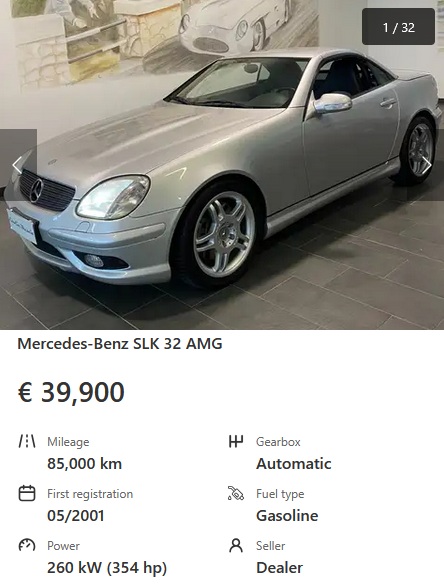
For a ’90 s Mercedes the R170 is surprisingly light — a shade over 1.2 t in SLK 200 trim — so even the base engine can show a bit of claw. At the other end of the scale sits the SLK 32 AMG with 354 PS and 0-100 km/h in 5.2 s, but a tidy AMG costs at least three times the budget we’re talking about here.
The “Convertibles under €10 k” series continues
In the previous instalment we covered the R171; earlier episodes looked at the BMW 3-series Cabrio. Today we step back one generation to see whether the (even cheaper) R170 is a hidden gem, a money-pit or perhaps a safe alternative to the newer Mercedes roadster R171.
Typical faults — what to watch on an R170
SLK 200 / SLK 200 Kompressor (M111, 136–192 PS)
• Head-gasket seepage around 150 000 km
• Kompressor clutch wear at ~150 000 km (on “K”)
• MAF and crank-sensor failures → rough idle, hard startsSLK 230 Kompressor (M111K 2.3, 163–197 PS)
• Same issues as the 200 K, plus higher blower load
• Supercharger often needs rebuilding after 200 000 km
• Cracking vacuum lines feeding the Kompressor clutch
SLK 320 (M112 V6 3.2, 218 PS)
• Generally the most reliable drivetrain in the range
• Minor oil weeps from the rear main seal or valve-cover backs
SLK 32 AMG (M112K V6 3.2, 354 PS)
• Charge-cooler radiator can clog
• Expensive brakes (345 mm discs)
All versions
• Rust on arches, door edges, floorpan (weak factory paint 1993-2004)
• Roof hydraulics: leaking rams, oil in the head-liner, slow mechanism
• Interior “soft-touch” paint rubs off
• Worn bushes/ball-joints → knocking over bumps