Introduction
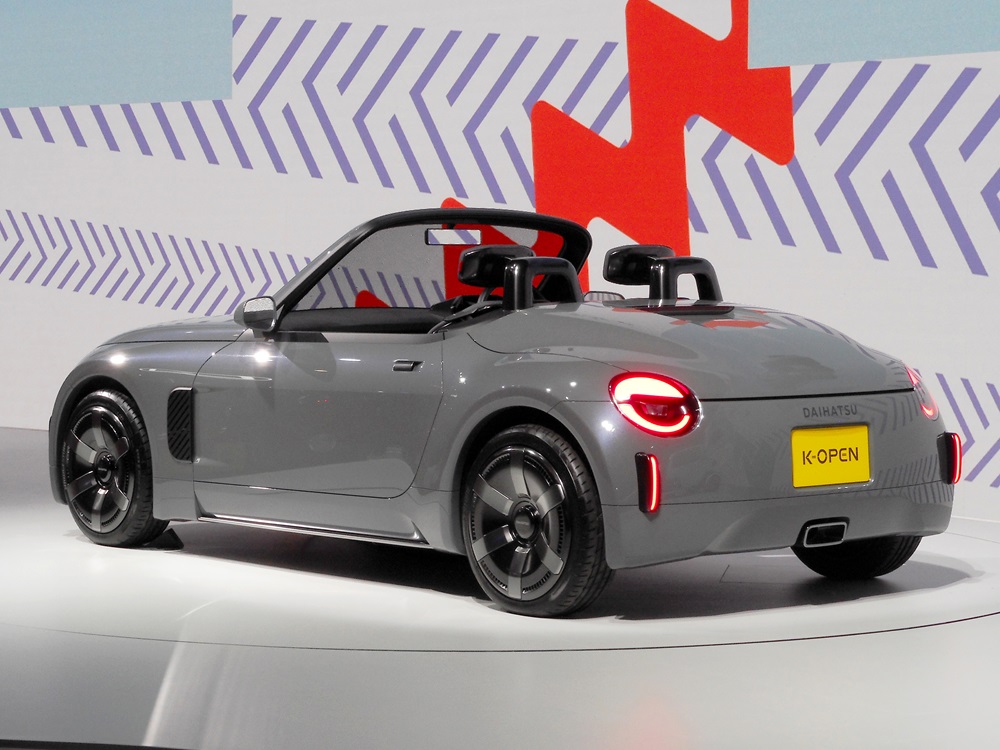
The Daihatsu K-Open presented at Japan Mobility Show 2025 is the spiritual successor to the Daihatsu Copen, still a lightweight, small roadster maintaining kei-car dimensions and featuring a likely turbocharged 660 cc engine, but with rear-wheel drive. While the classic Copen came in both a kei 660 cc version and a “full-size” 1.3-liter variant for international markets, the K-Open returns to its kei roots, with talk at this stage focusing exclusively on the 660 cc unit, backed by an ambitious promise of even more “purist” driving sensations.
The Return of the Small Roadster: K-Open at Japan Mobility Show 2025
At Japan Mobility Show 2025, Daihatsu unveiled a model that warmed the hearts of small convertible fans, myself included: the K-Open: openly signaling continuity with the existing Copen. It’s a small, two-seater roadster with a soft top, rear-wheel drive, and an engine that fits within kei car regulations.
Daihatsu emphasizes that the K-Open is designed to deliver “emotions that only a kei car can provide”, light construction, compact dimensions, ease of handling, and a low barrier to entry for drivers wanting something more than an ordinary hatchback.
The K-Open appears on the Daihatsu stand as:
- A concept car, but one firmly “grounded in reality,” repeatedly called by media as “practically ready for production”
- A front-engine, rear-wheel-drive (FR) vehicle – a rarity in the kei class
- An evolution of the earlier Vision Copen concept from 2023, but returning to full compliance with kei dimensions (3,395 mm length, 1,475 mm width, exactly at the regulatory ceiling)
Copen – Where We Started: A Brief History and Two Engine Philosophies
The Daihatsu Copen is already a cult model: a small, two-seater convertible that since its 2002 debut combined kei-car engineering with the image of a mini-MX-5. The first generation on the Japanese market and many Asian markets featured a turbocharged, three-cylinder 660 cc engine compliant with kei regulations. Later, on export markets (Europe, including the UK), a second face of the Copen emerged: a 1.3-liter K3-VE engine (DOHC, DVVT) producing 64 kW (roughly 87 hp) and 120 Nm.
In simplified terms, the Copen existed in two engine “worlds” over the years:
- Japan/kei: 660 cc turbo, 64 hp, 92 Nm
- Export markets: 1.3-liter naturally aspirated, 87 hp, 120 Nm
The production Copen is ending its life in 2026, which has already been officially announced, the K-Open is meant to be its spiritual successor, filling the gap left by one of the last truly small, combustion-engine roadsters.
K-Open: Technical Concept and Character
Key Assumptions for K-Open:
- Engine: 660 cc: compliant with kei regulations, with high probability of being turbocharged (continuing the Copen philosophy and kei requirements)
- Drivetrain: FR layout (engine in front, drive to rear), unlike earlier Copen generations, which were front-wheel-drive (FF) cars
- Manual Transmission: The prototype displays a 5-speed manual gearbox, a strong nod to purists
- Lightweight Construction: Approximately 850–900 kg (though exact weight figures haven’t been revealed; the kei philosophy and statements from company representatives clearly indicate that minimizing weight and prioritizing driving sensations are the priority)
An Interesting Detail
One curious observation: the gear lever appears to be a classic manual despite only two pedals being visible, suggesting that early prototype examples may be playing with form and could hint at an automated gearbox with a “manual” look. However, other materials explicitly mention a 5-speed manual, so the direction is clear: enthusiasts will get a classic, engaging drivetrain.
Toyota President Koji Sato and Akio Toyoda (who will serve as “master driver”) have publicly emphasized that K-Open’s greatest challenge is precisely packaging a classic FR layout into such a small body while maintaining balance and practical kei-car parameters. This sends a fairly clear signal: the chassis setup will be one of the main selling points of the car.
The 660 cc K-Open is intended to maintain the displacement limit while combining it with rear-wheel drive and a more refined FR platform that Toyota/Daihatsu are developing with driving enjoyment in mind. Even with similar power and torque figures, the purity of response, cornering balance, and “feel of the rear” should be incomparably better than the Copen FF.
Project Lead: Designed with the involvement of Akio Toyoda, strong emphasis on balance, steering feel, and “tactile” rear-axle feedback, fundamentally aimed at driver enjoyment.


What About the 1.3-Liter Engine?
With the Copen 1.3-liter, the logic was straightforward: stepping beyond kei limits and offering European customers a “fuller” car, more power, higher top speed, longer gear ratios, more highway-oriented character. The 1.3-liter K3-VE was used where regulations didn’t mandate 660 cc.
Should the K-Open reach production, a repeat of the Copen scenario cannot be ruled out: JDM/kei 660 cc plus a separate 1.3-liter variant for export markets. For now, however, this is speculation – only the kei character has been officially confirmed.
Market Context and the Future
The Copen ends production in 2026, and combined with the K-Open’s presentation in 2025, this looks like a textbook changing of the guard. The world of combustion-engine cars is shrinking, particularly in the small roadster segment, making the K-Open potentially:
- One of the last new combustion-engine roadsters in the ultra-compact segment, though I hope the market for fuel-engine cars turns around
- A collector’s piece – if it reaches production remaining faithful to the concept (FR, manual, 660 cc turbo)
- An interesting alternative to the MX-5 for those who prioritize lightness and “kei car feel” over power and size
Daihatsu has not yet officially announced specific performance figures or a production launch date. However, the narrative around the project, Toyota’s involvement, and messaging styled as “the Copen’s successor” suggest treating K-Open more as a preview of a production car rather than a pure, reality-detached vision.
Personal Perspective
For me, this is the answer to my petrolhead prayers. This could be an answer to the genuine lack of competition for the Mazda MX-5 and a counterweight to the presentation of only large, expensive, and very expensive convertibles. In my view, this is a good direction to make convertibles accessible to customers with more modest budgets.