
That one frame that changes everything
I have known the Jaguar E-Type model for a long time. I have known about the existence of the roadster version for a long time. I have admired this silhouette for a long time. But since “yesterday,” the level of my delight has increased many times over. It happened in front of the screen while watching the scene from “The Wolf of Wall Street” featuring a bright yellow Jaguar E-type Roadster. It is a manifestation of style, self-confidence, and the absolute freedom that comes from driving a convertible. Just as the character of Donnie Azoff, played by Jonah Hill, inspired the main character played by DiCaprio to start working ruthlessly and immediately, it inspired me to take a closer look at this model and write the following text.
Looking at this car in Primrose Yellow, I understood even more why Enzo Ferrari called it the most beautiful car in history. On Cabriolog, I often write about technology, but this time I want to start with a feeling – with that delight that makes you want to drop everything, get behind the wheel, and feel the wind in your hair. The E-type is not an ordinary classic. It is a promise of adventure that we will break down into its prime factors together today.
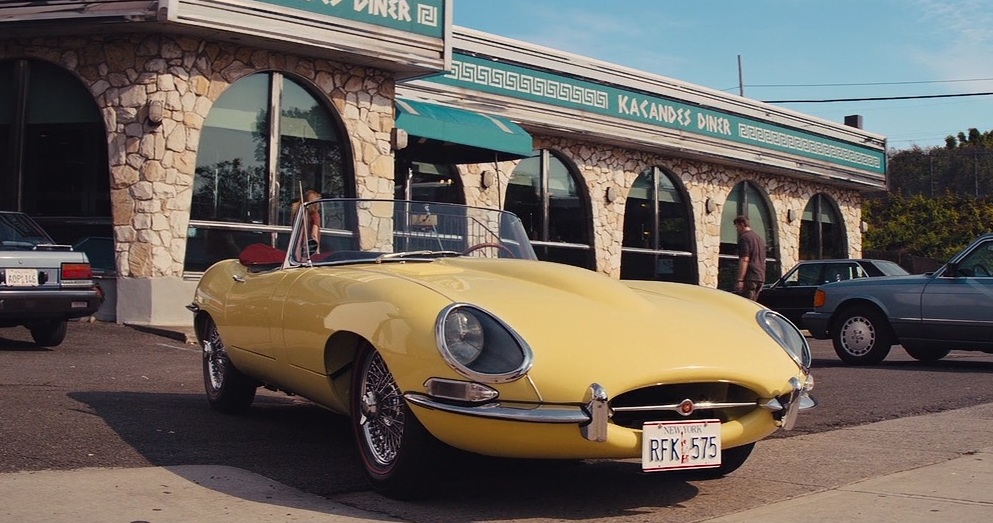
Yellow E-type – The Star that eclipsed DiCaprio
Although Martin Scorsese’s film is mainly associated with the white Lamborghini Countach, which I respect and admire, although I never felt love for it, it was this yellow Series 1 Jaguar that stole my heart. Why does this frame work so well on the imagination?
- Contrast: The Primrose Yellow color on the Roadster is a combination of British elegance and California sun. In a world of boring, modern cars, often still boxy, this sight is like a lightning bolt… a lightning bolt with an insanely long hood.
- Symbolism: In the film, the Jaguar represented the peak of possibilities – a car for people who do not ask for permission, a car for which someone can change their job in fifteen minutes.
- Details: Chrome wire wheels, a long hood line (it is so long that I could write about it all the time).


The history of creation: From the Le Mans track to public roads
The E-type did not come from nowhere. Its construction is a direct legacy of the racing D-type model, which serially won the 24 Hours of Le Mans. Malcolm Sayer was responsible for the project, a genius of aerodynamics who, instead of focusing on “style”, focused on mathematical equations of air flow.
The premiere was such a great success that Jaguar had to hurriedly bring a second test copy from the factory in Coventry to Geneva to satisfy the curiosity of journalists. The car offered a speed of 150 mph (approx. 240 km/h) for a fraction of the price of an Aston Martin or Ferrari, which shocked the market at the time.
The heart of a predator: Technical aspects and engines
Under the long, impressive hood of the E-type, units that became legends were hidden:
| Engine | Series | Characteristics |
| 3.8 R6 | Series 1 | The most raw, aggressive, with an aluminum interior finish. (this one was in the movie) |
| 4.2 R6 | Series 1 & 2 | More torque, better gearbox synchronization, and more comfort. |
| 5.3 V12 | Series 3 | Powerful, velvety power. Ideal for long distances (Grand Tourer), although with different handling characteristics. |
Construction-wise, the E-type was a breakthrough: it had independent rear suspension and disc brakes on all wheels, which was not a standard in road cars in the 1960s at all (sick!).
Market availability: Where to look for the dream?
Finding the perfect Roadster is a challenge for the patient.
Auctions: The best examples (so-called concours condition) appear at RM Sotheby’s or Gooding & Company auctions. Import from the USA: Many cars originally went overseas. Today they are returning to Europe, but they often require conversion (e.g., changing carburetors from choked American versions to European SUs). Traps: When buying, bodywork documentation is key. The E-type does not have a frame, but a semi-monocoque structure – corrosion in key places can mean a renovation exceeding the value of the car.
Value forecasts: Is it still a good investment?
The Jaguar E-type is a so-called blue chip of the classics market. This means that its value is stable and has an upward trend.
Most sought after: Early Series 1 models with a 3.8 engine and “flat floor” are today an expense of 250,000 – 400,000 EUR. Opportunities: Series 2 and 3 are slightly cheaper, but their prices are also systematically rising, especially in the Roadster version. Forecasts for 2026 are clear: in a world dominated by electric cars, analog works of art like the E-type will only get more expensive.


Summary: More than a car
The Jaguar E-type Roadster is not just a means of transport. It is emotions, the smell of gasoline and leather, and the sound of the inline “six,” which sounds best in the world with the top down. If you are looking for a convertible that will change your approach to motoring forever – the E-type is the answer. Can you buy an E-type Roaster? What are you thinking about?! Buy it!
Technical Heart: The Evolution of the Feline Power
While the E-type’s body is a work of art, its soul lies beneath that long, iconic bonnet. Over the years, the E-type evolved from a raw, race-bred machine into a sophisticated Grand Tourer.
Engine Specifications & Performance Table
| Feature | Series 1 (3.8 L) | Series 1 & 2 (4.2 L) | Series 3 (5.3 L V12) |
| Production Years | 1961–1964 | 1964–1971 | 1971–1974 |
| Engine Layout | Inline-6 (XK Engine) | Inline-6 (XK Engine) | V12 |
| Displacement | 3781 cc | 4235 cc | 5344 cc |
| Max Power | 265 bhp | 265 bhp* | 272 bhp |
| Max Torque | 260 lb-ft @ 4000 rpm | 283 lb-ft @ 4000 rpm | 304 lb-ft @ 3600 rpm |
| 0-60 mph (0-97 km/h) | ~ 6.9 sec | ~ 7.0 sec | ~ 6.4 sec |
| Top Speed | 150 mph (241 km/h) | 153 mph (246 km/h) | 146 mph (235 km/h) |
| Fuel System | Triple SU HD8 Carbs | Triple SU HD8 Carbs | Quad Zenith-Stromberg |
*Note: While the horsepower figures remained similar on paper, the 4.2L engine provided significantly more torque, making it much more drivable in modern traffic. US-spec models often saw reduced power due to strict emissions regulations.
Check also my text about Alfa Romeo Spider from The Graduate (1967)