

Mercedes-Benz SLK R171. The second-generation Mercedes SLK (factory code R171) made its debut in 2004 as the successor to the popular R170.
Compared to the first iteration of this iconic roadster, the R171 brought more elegance, modern technology, and styling cues inspired by the Mercedes-Benz SLR McLaren supercar. A mini-SLR, if you will… and the AMG version is just 0.6 seconds slower from 0 to 100 km/h than the “regular” SLR itself. SICK!
From the very beginning, the SLK was seen as a rival to the BMW Z4 and Porsche Boxster, standing out with its signature “Vario Roof” hardtop that could transform the car from a coupe into a full-fledged roadster in just a few seconds. The R171 was produced until 2011, with a facelift in 2008 that refreshed its exterior design, updated the interior with new features, and most importantly, introduced improved engines.
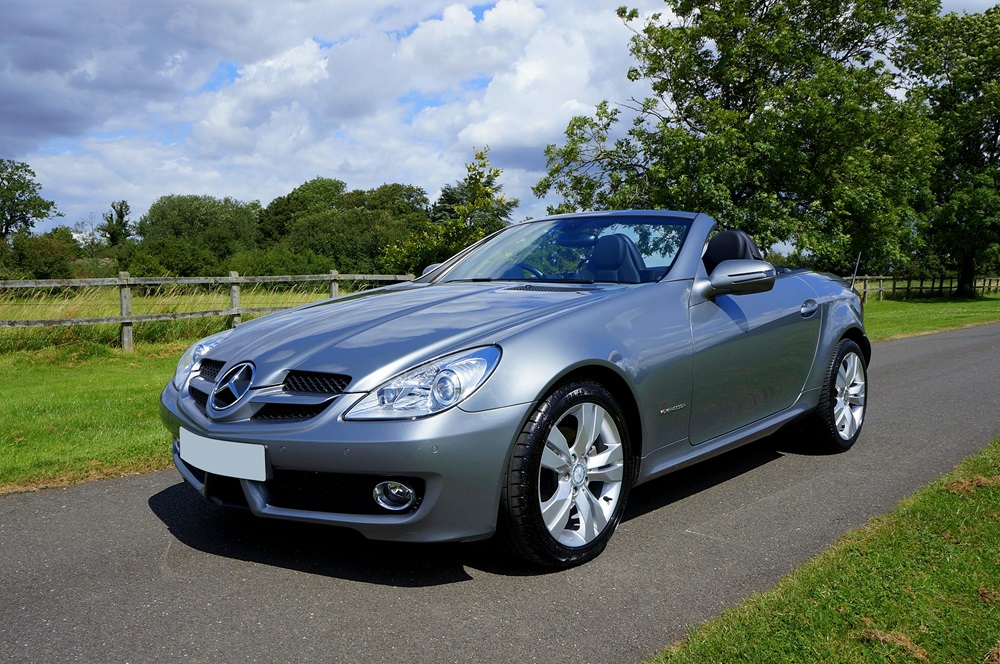
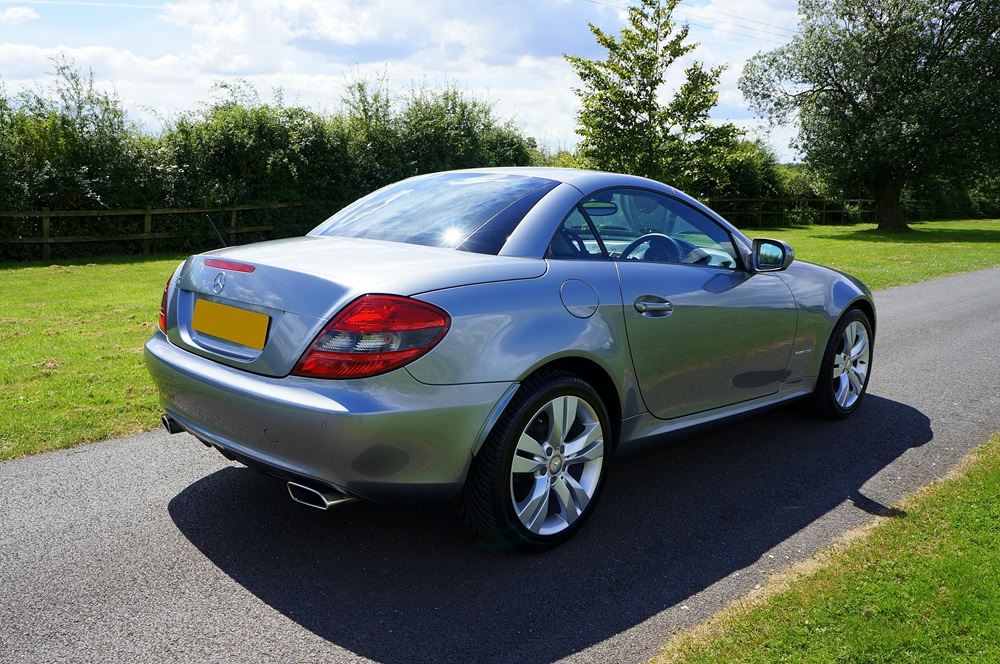
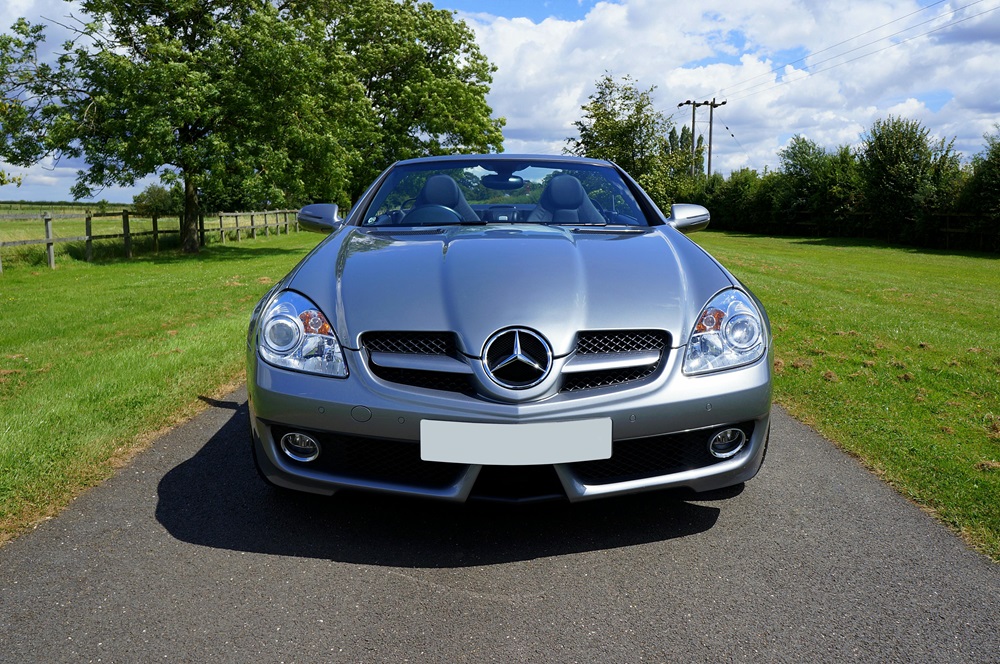
The SLK R171 gained popularity thanks to its ideal blend of sporty performance and typical Mercedes luxury. The wide range of powertrains allowed buyers to choose a version tailored to everyday usability or more dynamic ambitions. That’s why the SLK R171 became one of the most desirable roadsters in the premium segment—now available for relatively modest money on the used market. But here’s the catch: the second-hand market is flooded with these cars. The question is: are all of them as good as we’d like?
Continuing the Series: Convertibles Under €10,000
In the previous article, we looked at the BMW 3 series Cabriolet, another characterful car that’s also available within a €10,000 budget (main article). Check out the main article for a full list of 32 cars — each one with its own in-depth review!
Common Engine Issues in the Mercedes SLK R171 – What to Watch Out For
SLK 200 Kompressor: Engine: 1.8L M271 Supercharged I4
Typical problems for M271 engines (both pre- and post-facelift):
- Timing chain wear and noise: Particularly common in models produced up to 2006. Symptoms include a rattling sound on cold starts and, in severe cases, timing chain jump leading to valve damage. Post-2008 models (184 hp version) had an improved tensioner and modified chain design, reducing this risk.
- Supercharger wear (Roots-type): Usually occurs after around 200,000–250,000 km. Signs include power loss, whining noises, and poor throttle response. Later versions (2008+) had slightly improved ECU calibration for smoother throttle behavior, though the mechanical unit remained the same.
- Ignition coil and spark plug failure: Fairly common. Symptoms include rough idling, hesitation, and the Check Engine light.
- Oil leaks from valve cover and crankshaft sensor area: Small oil leaks are very common. Oil may drip onto the hot exhaust manifold, causing a noticeable burning smell.
SLK 280 (2005–2008) and SLK 300 (2009–2011)
Engine: 3.0L V6 M272 – 231 hp / 300 Nm
- Reliability: Both SLK 280 and SLK 300 use the same 2,996 cc M272 engine. The difference is mostly in the name, updated after the facelift. The major issue in the earlier SLK 280 was the balance shaft gear failure, particularly in engines with serial numbers up to 2729..30 468993. Later models or those with higher serial numbers are unaffected.
- Summary:
- SLK 280 (2005–2008): Higher risk of costly balance shaft gear failure.
- SLK 300 (2009–2011): Updated version with the defect resolved; better choice for long-term reliability.
SLK 350 (2004–2007) and SLK 350 (2008–2011)
Engine: 3.5L V6 M272 – 272 hp (pre-facelift), 306 hp (post-facelift)
- Reliability: Same base engine as the 280/300 but with more power. The 2004–2007 models also suffered from balance shaft gear issues. The 2008 facelift introduced improved timing components and more power, eliminating the earlier design flaw.
- Additional issues:
- Both versions can suffer from high oil consumption.
- Ignition coil and crankshaft sensor failures are common across all M272 engines.
- Summary:
- SLK 350 (2004–2007): Risk of expensive timing gear repair.
- SLK 350 (2008–2011): Safer and stronger choice.
R171 Within a 10,000 EUR Budget
After a thorough analysis, I can confidently say that if you’re looking at buying a Mercedes SLK R171, it’s definitely worth aiming for a facelifted model (post-2008), especially for the SLK 200 Kompressor or the V6 versions labeled SLK 300 and SLK 350. These newer variants are free from the most expensive design flaws—mainly the timing gear issues in the V6 engines—and benefit from a refined version of the M271 in the 200 Kompressor. In terms of driving dynamics, interior feel, and overall refinement, the facelifted SLK feels more mature and well-rounded. The differences may not seem dramatic on paper, but behind the wheel, they’re very real.
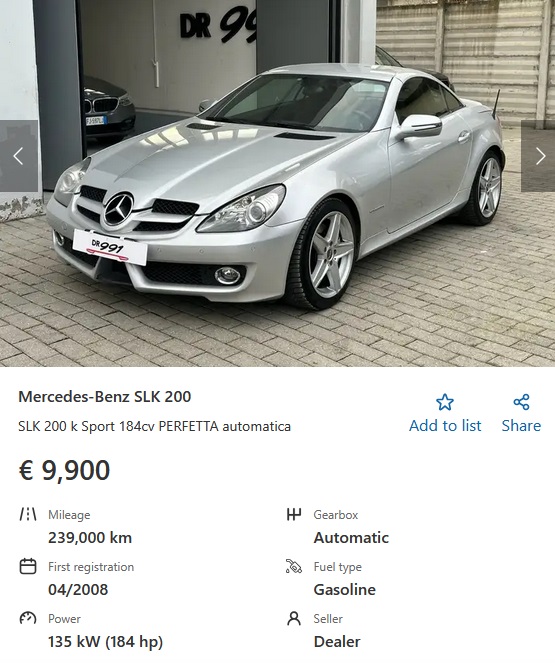
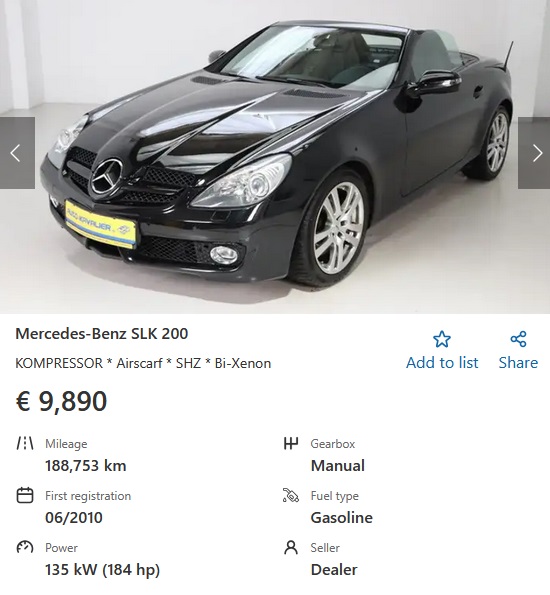
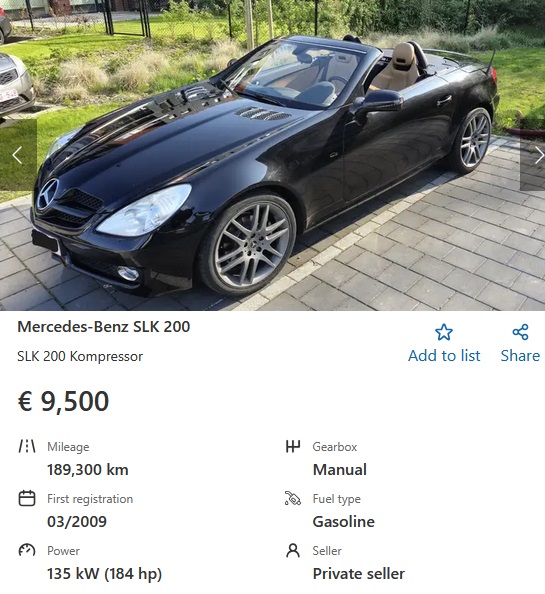
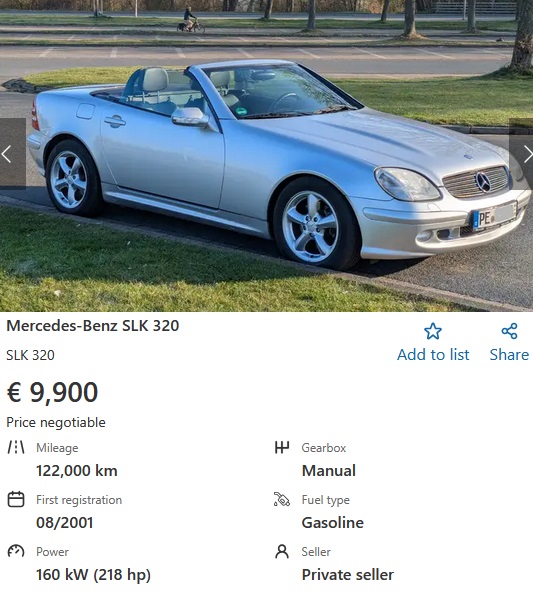
So how does this all align with a 10,000 EUR budget? Unfortunately, if you want one of the facelifted engines—whether the supercharged I4 or the naturally aspirated V6—you’ll have to limit yourself to the SLK 200 Kompressor (184 hp). Both the SLK 300 and SLK 350 with 306 hp are practically out of reach in this price bracket. If you’re not comfortable risking a pre-facelift V6, then it might actually make more sense to look back to the first-generation SLK 320 (R170) with its 218 hp V6.
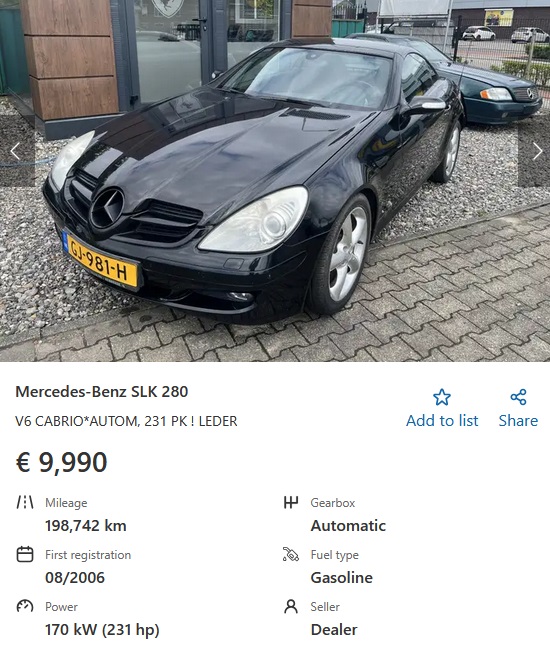
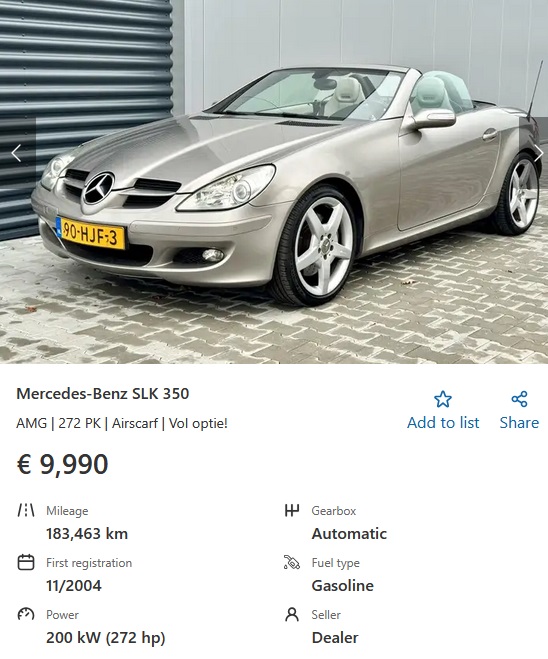
Returning to the R171: you can find SLK 280s starting from around 7,000 EUR, which might sound tempting—but remember, these come with a higher risk of the balance shaft gear issue. The SLK 350 (272 hp) is also common in the sub-10,000 EUR range and might be slightly safer than the 280, but still—low price often speaks volumes.
And while we’re here, I can’t help but mention the SLK 55 AMG with 360 hp and a 5.4L V8 (just 1,540 kg—2nd SICK!). But let’s be real: unless you’ve got at least 25,000 EUR, that’s not happening. As for the SLK 55 AMG Black Series with 400 hp? Not even on the radar. 10,000 EUR might cover a few payments on that one.
Final Thoughts
To wrap it up—if you’re in the market for a second-gen Mercedes SLK (R171) with a budget of 10,000 EUR, your best and safest bet is the facelifted SLK 200 Kompressor (184 hp). It offers solid performance while avoiding the major issues that plagued earlier versions, especially those with V6 engines. But if your heart is set on a silky V6 growl and you want to avoid the headache of expensive repairs on the 280 or 350, then the SLK 320 from the R170 generation is absolutely worth considering. It may not look as fresh, but in terms of reliability and peace of mind, it can outshine its younger siblings. In my opinion, the SLK 320 R170 might even hold its value better than a pre-facelift 280 or 350. Personally, I’d take the 320 over the 184-hp Kompressor—but that’s just me, probably because I had one…. SLK 230 Kompressor R170 in beautiful silver color…. as kid… Bburago 1:16.